Showing posts with label building. Show all posts

Oban Harbour

My favourite part of our visit to Oban yesterday was walking round the harbour area.  So much to see and photograph.


Oban started as a small fishing village, but the train link to Glasgow and the increase in steamer traffic and tourism in the late 19th century, saw it become the main hub between the western islands and the mainland.  It still is a popular holiday destination for those who want to explore the west of Scotland and the islands.


The tall ship Pelican has had an interesting history and is used, among other things as a training ship for young people.


There are some interesting buildings in Oban.  My particular favourite is this lovely red sandstone building from 1901.  I think it used to be the Royal Bank of Scotland - it is in George Street.  Love the architectural details - wonderful!


Hope you enjoyed this little trip to Oban.  Hope to go back during the summer when the sun is shining - if we ever get a summer, that is!

 Love, Liz

Rosslyn Chapel

Visited Rosslyn Chapel in Midlothian yesterday.  The last time we were there was about fifteen years ago, and its amazing how many changes there have been. 

Rosslyn became ultra-famous after it was mentioned in Dan Brown's "Da Vinci Code".  My heart sunk a bit when I saw signs for the car park, coach park and overflow car park -  the first intimation of the huge rise in visitor numbers.  Then there was the new "visitor centre" which you have to go through to get to the chapel - paying £8.75 each in the process!  There was a shop selling the usual tee shirts, playing cards, baseball caps etc and a cafe.   This is what greets you as you approach the chapel itself.


No photography inside - don't suppose my photographs would do it justice anyway.


Lots of conservation work going on so the place is covered in scaffolding.


Inside is amazing - its now heated and there are guides on hand to answer questions.  The carvings are magnificent and there are display boards explaining what everything is.


A lot of the outside of the building is still accessible and I took some photos - mostly of the cheeky little faces which are all over the building, both inside and out.  You can read about the Green Man symbolism here.


Overall, I was very disappointed with my visit.  When I knew we were going there, I thought, great, I'll be able to do a blog post about how wonderful Rosslyn is.  I had been absolutely fascinated, intrigued and awestruck on my previous visits all those years ago.  This time - I can only describe it as if someone had turned the atmosphere switch to OFF!


Can't even begin to imagine what it would be like in summer with coach loads of visitors!  The only good point was that there was hardly anyone else there yesterday, so we were able to wander around in peace and quiet with no kids running about.    But it didn't compare with the old days when you just wandered around an almost empty building and let your imagination take over as you gazed on the intricate stone carvings.  Usually I get a "buzz" from old buildings, but I'm afraid, despite the new bio-wonderful heating, Rosslyn left me cold!


Love, Liz

Church and School Going To Ruin

I am often in despair when I look around my local area and see lovely buildings boarded up and almost derelict.  These are prime examples. 


This is the former Clune Park School in Port Glasgow and while it may not be the prettiest building in the world, it has a couple of interesting features.  It was still a working school until 2008.  The school and the derelict church next to it - Clune Park Church - are part of a "regeneration strategy" which will take place some time in the future.


In the meantime, I wanted to get some photos of the buildings before anything happened to the interesting features.


Victoria and Albert don't look too pleased with their present predicament!


This is from the town crest - the Latin reads -

            Ter et Quater anno Revisens Aequor Atlanticum Impune

which translated is -

            three and four times a year revisiting the Atlantic with impunity

Its a bold and noble motto going back to better times in Port Glasgow's history and refers to the trans-Atlantic timber trade between here and Quebec.  This timber was used in the great shipyards which lined the River Clyde at Port Glasgow and Greenock.


Hope that something good is done with thes buildings before they are completely ruined.  I sometimes think that we (actually I mean the local council) are far too careless with our local heritage and need to literally and figuratively stop the rot!  (Sorry for the rant!) 

If you want to see another local example of a lovely building being allowed to lie derelict go to this post.


Love, Liz

Cottier's Hope

Our church is having some work done to the ceiling.  While that is going on, we will be worshipping at the beautiful Old West Kirk (now Lyle Community Kirk, Esplanade) in Greenock.  It has some lovely stained glass windows.  This particular panel caught my eye. 
(Remember if you click on the photos you will see them in more detail.)


It is called "Hope" and is by the Scot, Daniel Cottier.  The little legend at the bottom of the picture reads:-

Daniel Cottier glass painter places this window in the Old West to the memory of his grandfather Archibald McLean master mariner of this Port who died in the year 1847 aged 80 years.

The window was made by the famous William Morris & Co and was put in place in 1884.

The window depicts a beautiful woman.  Around her head are the letters ESPS - this was the name of the Roman goddess of Hope.  She stands in what appears to be a walled garden in which are a few flowers.  Esps was usually depicted holding a flower, again this is a symbol of spring and with it fresh hope and new growth. 

The upper half of the window has greenery, behind which can be seen the masts and rigging of a sailing ship - reference to Cottier's grandfather's occupation as master mariner. 


This seafaring imagery is also continued in the anchor (another symbol of hope and steadfastness) which is depicted in the little roundel which contains words from the New Testament book of Romans.  I am sure that for many of the mariners' wives and daughters, this would have been a comforting piece of scripture as at that time sea voyages lasted for many months, even years. 

I think that it is a beautiful window, so peaceful and serene.

Daniel Cottier was born in 1839 in Glasgow and served his apprenticeship with firm of glass stainers, John Cairney & Co.  Later he moved to London and studied under the famous artist Ford Maddox Brown.  He returned to Scotland and was responsible for the stained glass for many churches.  In 1869 he founded Cottier & Co in Regent Street in London.  In Australia he joined with fellow Scot to start the firm Messrs Lyon, Cottier & Co who had premises at 333 Pitt Street, Sydney.  He also opened a branch in New York.  He collaborated with and inspired Louis Comfort Tiffany.  A man of many talents, he worked on decorative interiors and furniture and was an important art dealer.  Cottier died in Jacksonville, Florida in 1891.  His body was taken back to New York where he was buried in Woodlawn Cemetery.

I am completely ashamed to admit that until Sunday, I had never heard of Cottier.  But, because I wanted to share this window with you, I had to find out a bit more about the artist.  I am so glad that I did.  If you want to find out more, you can check out the website of the Cottier Theatre, the former Dowanhill Church in the west end of Glasgow, decorated by Cottier and William Leiper in 1865, and which has had extensive restoration work done recently. 

That, to me, is one of the joys of blogging - you just never know quite where it will take you and what you will learn!

Love, Liz

Towers and Turrets

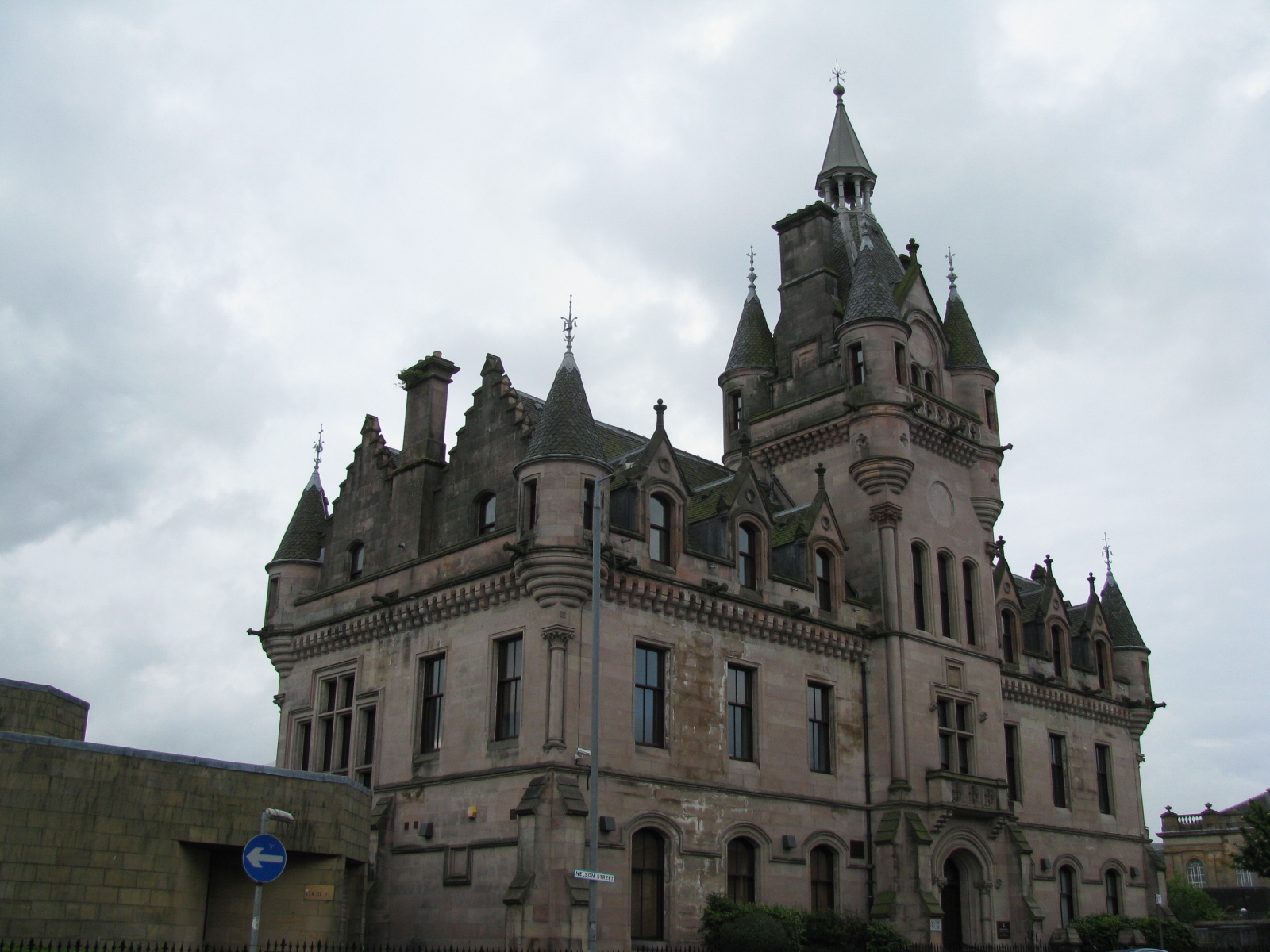
Who do you think would live in a place like this?


Towers and turrets .................... pinnacles and spires.


A  pretty princess perhaps, or a dastardly duke?


No - actually its the Greenock Sheriff Court building! 


Finished in 1869, it is built in the Scottish baronial style of architecture.  Part of the 19th century gothic revival, it incorporates many elements from medieval buildings, such as the turrets and towers.


Greenock Sheriff Court

I think it looks like a fairytale castle from certain angles.  The reality is much more mundane.


Newark Castle
To see original medieval architecture, check out my post on Newark Castle in Port Glasgow.

Love, Liz

Doors Open Day - Bridgeton Heritage Trail

I absolutely love Doors Open Days.  This year a friend and I decided to go on the Bridgeton Heritage Trail in Glasgow.  It was absolutely fantastic - not just for the wonderful architecture, but also for the marvellous insight into life in Bridgeton in the past.  Our guide was very knowledgeable and enthusiastic which made the tour even more enjoyable.  Bridgeton is to the east of Glasgow Green.


Here are some highlights.  This is the fountain erected in memory of Bailie (Scottish civic office) James Martin in 1894.  Looks like lace, doesn't it - amazing workmanship!


This building is absolutely amazing and I'm glad it was such a beautiful day for taking photographs.  It was built as a private residence for a mill owner in 1846.  In 1859 it was converted to a school with money from Glasgow merchant James Buchanan.  Named the Buchanan Institute for Education and Industrial Training, it took in destitute boys and gave them the chance of a better future.


The pediment was added in 1873.  Wonder how many boys benefited from this establishment.


Right next to this is the former Logan & Johnston School of Domestic Economy (1890).  Love this sculpture of a beehive - symbol of industry.


Great sculpture on Bridgeton Public Library - still in use today.  In fact, on our tour was a woman who had worked there years ago then left for America.  She was visiting for the first time in ages.  Think it was quite an emotional tour for her.


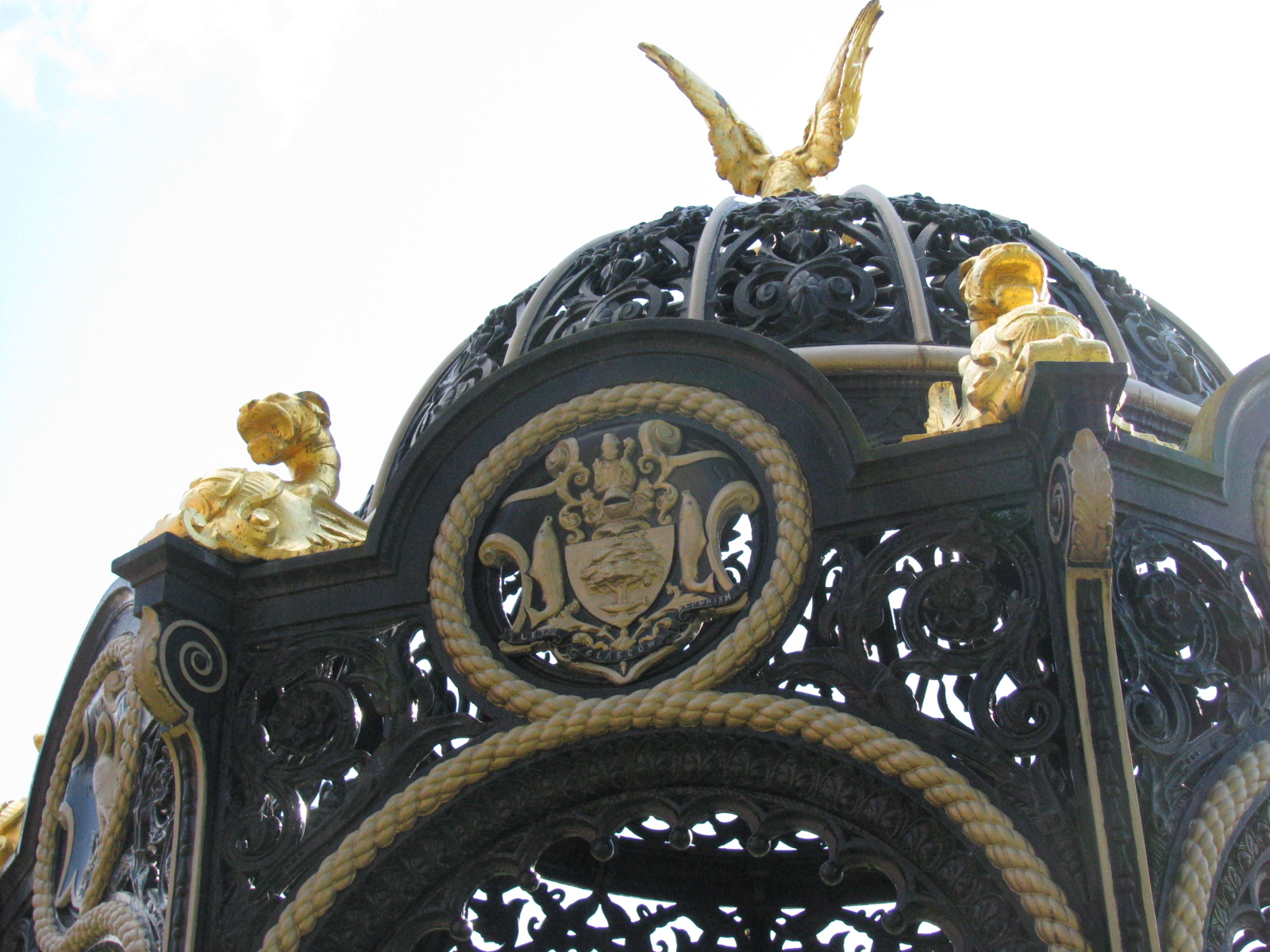
Perhaps one of the most famous landmarks of the area is the Bridgeton Cross Shelter, or the Bridgeton Umbrella as it is more commonly called.  It really is quite striking. 


The area seems to be undergoing a bit of a facelift.  Its very encouraging when councils recognise the importance of their heritage and ensure that it is saved to be passed on to future generations.


That, I think, is one of the most important aspects of Doors Open Day - local people exploring and revisiting what is on their doorstep and learning to appreciate it through the efforts of local heritage groups and volunteers.


Let Glasgow Flourish

You can actually follow the Bridgeton Heritage Trail on the Glasgow City Council website.  There's lots of other interesting articles there too.

Love, Liz

Stitching resolutions

My cross stitch resolution for this year is simple!  I must finish these two gigantic projects that I started many moons ago! I feel a bit g...